


Dear Friends,
We come to the end of Pope Leo’s encyclical, Magnifica Humanitas. I hope it has caused you to reflect and perhaps change the way you see our world and the use of AI. He concludes with a few challenges:
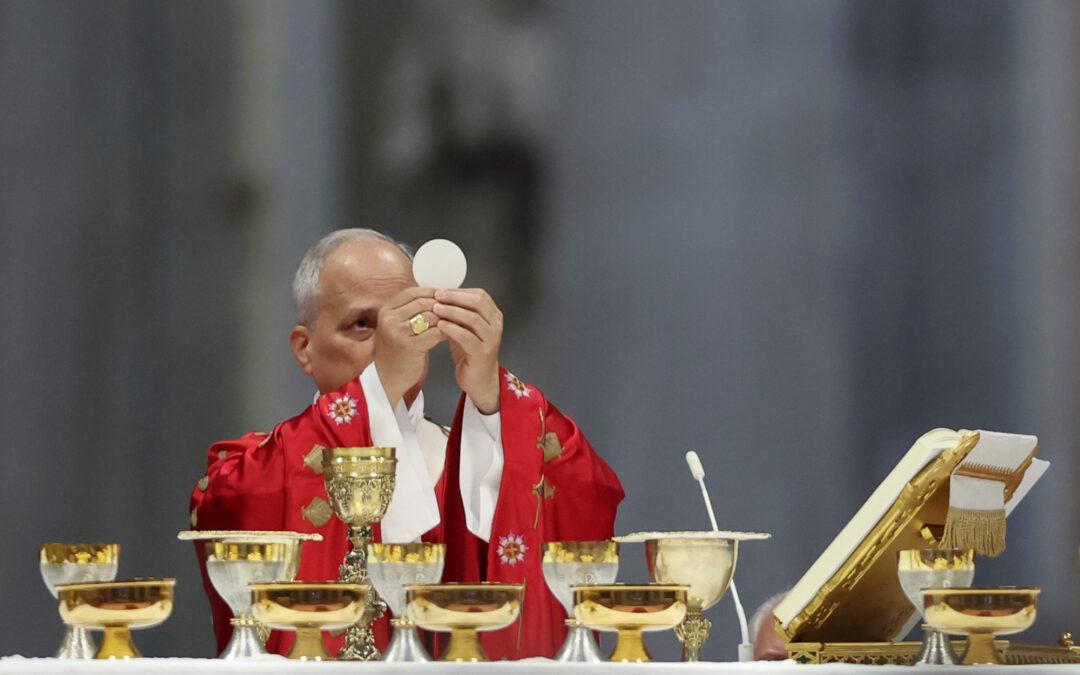
…The spirituality that we need is a Eucharistic spirituality, that is, a spirituality of ecclesial unity in love. The Incarnation and the Paschal Mystery reveal God entering into our human condition and transforming it through the gift of himself. This gift remains present and active in the Eucharist, in which the Lord gives himself and gathers the Church together, so that his offering becomes the principle of unity and source of new life. It is from this communion that Christian solidarity also arises, since “union with Christ is also union with all those to whom he gives himself.”
…Let us remain faithful to the truth! Living amid incessant flows of information, opinions and images, we know how easy it can be to influence decisions and preferences through increasingly sophisticated algorithms. In this context, it is imperative to cultivate hearts that love the truth, prefer what is right despite the most appealing content and pursue wisdom rather than immediate results.
…Let us invest in education, beginning with ourselves! We all need to learn how to engage with the digital world in a human way, as an integral part of our education in the faith and in a life lived according to the Gospel. Indeed, we must consider the digital world as a new continent to be evangelized, one that requires generous missionaries who are mature in the faith.
…Let us cultivate relationships! In an era that favors speed and fragmentation, the human person still yearns to receive care and recognition from attentive minds, kind words and hands capable of tenderness. The digital culture multiplies connections and offers new opportunities for interaction; yet, the human heart retains an irrevocable need for genuine closeness.
… Let us love justice and peace! The same technologies that facilitate communication and access to resources can also support models that exploit the most vulnerable, create new forms of slavery and derive profit from conflict. Every technical or economic decision should include spiritual discernment and be an opportunity for assessing whether the advances in AI are promoting justice and participation or concentrating wealth and power in the hands of a select few.
…After having considered faith, which contemplates the Father’s loving plan; love, which unites us in one ecclesial body; and hope, which sustains our actions in the world, the fourth pillar of this program for Christian life is prayer. Mary’s song accompanies our commitment. Before Elizabeth who announces to her that she has become the mother of the Lord, Mary bursts into a hymn of praise and joy. Her soul magnifies the Lord, and her spirit rejoices in God her Savior, for he chose a young, poor and humble girl for his plan of salvation. Mary suddenly sees all of history through the lens of this revelation. Nothing has changed around her; the socio-political situation of her time remains the same. The Romans continue to control her land, and her people are still subjugated and humiliated. Yet, everything has changed within her, and this allows her to see what is invisible. God has already shown the strength of his arm; he has already scattered the proud, cast down the mighty, lifted up the lowly, filled the hungry with good things and sent the rich away empty-handed. He has already helped Israel, his servant. God “takes the part of the lowly. His plan is one that is often hidden beneath the opaque context of human events that see ‘the proud, the mighty and the rich’ triumph. Yet his secret strength is destined in the end to be revealed.”
…With the same faith as Mary, let us become “weavers of hope” in our world, sharing who we are and what we have, so that the presence of Jesus may grow among us and his Kingdom take shape.
Peace,
Fr. Damian