


Dear Friends,
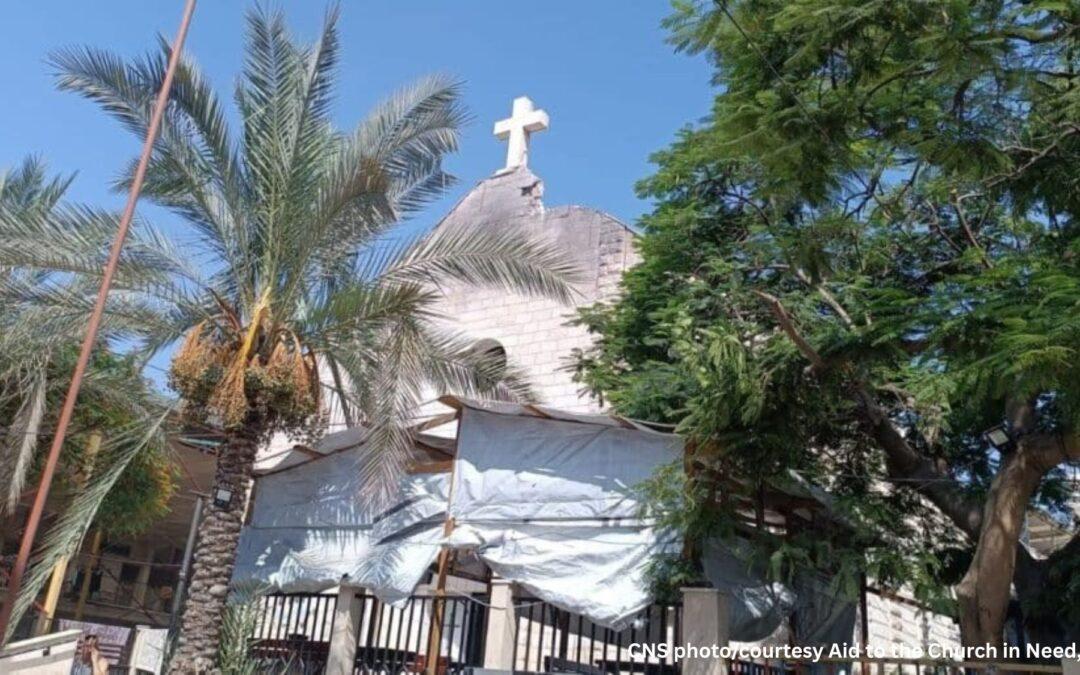
When the news reported July 17 on the deaths of three people at Holy Family Church in Gaza, some of you might have been confused. Perhaps that’s because most of the time the Israeli-Palestinian conflict suggests just two communities are caught in the crossfire: Israelis (uniformly Jewish) and Palestinians (exclusively Muslim).
However, it’s not so simple. Jews comprise around 73% of Israel’s population while roughly 21% are Arabs. Arab citizens of Israel are mainly Muslims but also include Christians and Druze. In the Palestinian territories (West Bank, Gaza) roughly 99% of the population is Muslim. The remaining 1% is mostly Christian and even includes descendants of the biblical Samaritan community.
I did a sabbatical in Israel ten years ago at the Tantur Institute, run by Notre Dame University. We had the opportunity during our studies to meet leaders from the different communities as we strove to understand the events that have taken place in that land, both 2,000 years ago and in the last hundred years.
There are Arab Catholics living in Israel and Palestine. In fact, there is a seminary located in Beit Sahour, near Bethlehem, serving dioceses in Palestine, Israel, and Jordan. During my first trip to Israel in 2001, we spent a couple days at the seminary and enjoyed Passover with them. One of the old professors at that seminary had been the spiritual director for Yasser Arafat. It was quite fascinating to talk with him about how the leader of the PLO moved from practicing violence to peace.
When Israel was created in 1948, thousands of Palestinian Arab Christians were displaced, settling in neighboring countries and further afield. Today, Palestinian Christians can be found in places as diverse as villages in the West Bank, in the suburbs of the Lebanese capital, Beirut, and the streets of Omaha. The largest Palestinian community outside of the Middle East today is in Chile. Cardinal Fernando Chomalí Garib, the Archbishop of Santiago, has Palestinian roots.
While the Catholic community in Palestine and Israel is small compared to the recent past, still they form an important part of the community in the Holy Land. Imagine if all the Christians left the Holy Land. Then the tears Jesus cried over Jerusalem would need to be shed all over again.
I grant that the situation in Israel is very complex. Those of you who accompanied me in 2021 on our Holy Land pilgrimage saw firsthand some of the sufferings of the Palestinian people. The answers are not easy and will require, as Pope Leo said last week, courage and pain on all sides.
If you are interested in a balanced view of the conflict, I would encourage watching or reading anything by Fr. David Neuhaus. (Here is one suggestion where he is speaking in Rome on the concept of hope: laycentre.org/full-video-david-mark-neuhaus-sj-on-hope-waking-up). Fr. Neuhaus is a Jesuit priest who has lived among both Palestinians and Israelis. He gave several presentations while I was at Tantur. Born in South Africa to Jewish parents, Neuhaus first arrived in Israel at the age of 15 and has since spent most of his life there. After converting to Roman Catholicism, he began an academic career and is now a guest professor of sacred scripture, biblical theology and Judaism at Salesian Pontifical University’s Jerusalem campus.
Pray for peace in the Holy Land. May the suffering of the innocents come to an end.
Peace,
Fr. Damian