


Dear Friends,
This weekend, our pilgrimage group is in Rome with Pope Leo and thousands of other pilgrims
who are celebrating the Jubilee Year. We are only spending three days in Rome but thought it
important to end here because of the Jubilee Year and because it is where St. Paul finished his
journeys. Since I am unable to write a letter while on the journey, you once again get to read
Pope Leo’s thoughts from a recent audience:
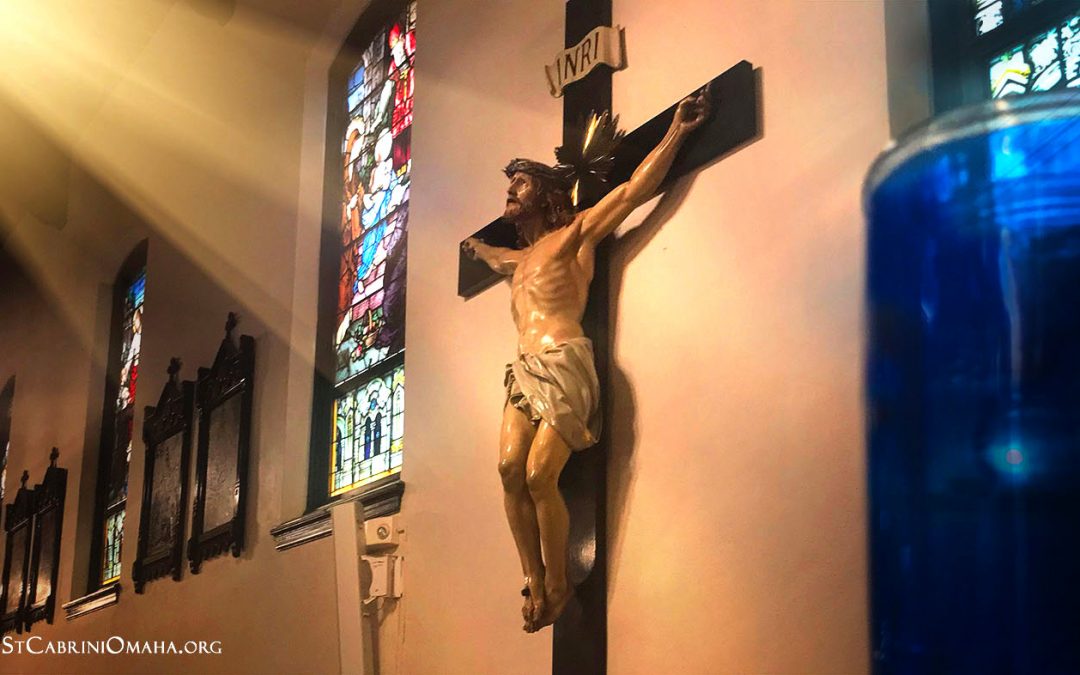
Today we will contemplate the culmination of Jesus’ life in this world: his death on the cross. The
Gospels attest to a very precious detail, which is worthy of contemplation with the intelligence
of faith. On the cross, Jesus does not die in silence. He does not fade away gradually, like a light
that burns out, but rather he leaves life with a cry: “Jesus uttered a loud cry, and breathed his
last.” That cry contains everything: pain, abandonment, faith, offering. It is not only the voice of
a body giving way, but the final sign of a life being surrendered.
The cry of Jesus is preceded by a question, one of the most heart-rending that could be uttered:
“My God, my God, why hast thou forsaken me?”. It is the first verse of Psalm 22, but on Jesus’
lips it assumes a singular weight. The Son, who always lived in intimate communion with the
Father, now experiences silence, absence, the abyss. It is not a crisis of faith, but the final stage
of a love that is given up to the very end. Jesus’ cry is not desperation, but sincerity, truth taken
to the limit, trust that endures even when all is silent.
At that moment, the sky darkens and the veil of the temple is torn. As is as if creation itself was
participating in that pain, and at the same time revealing something new. God no longer dwells
behind a veil – his face is now fully visible in the Crucified One. It is there, in that broken man,
that the greatest love manifests itself. It is there that we can recognize a God who does not
remain distant, but who traverses our pain to the very end.
The centurion, a pagan, understands this. Not because he has listened to a speech, but because
he saw Jesus die in that way: “Truly this man was the Son of God!” It is the first confession of
faith after the death of Jesus. It is the fruit of a cry that did not vanish in the wind, but touched a
heart. At times, what we are unable to say in words, we express with the voice. When the heart
is full, it cries. And this is not always a sign of weakness; it can be a profound act of humanity.
We are accustomed to thinking of crying out as something disorderly, to be repressed. The
Gospel confers an immense value to our cry, reminding us that it can be an invocation, a
protest, a desire, a surrender. It can even be the extreme form of prayer, when there are no
words left. In that cry, Jesus gave all that he had left: all his love, all his hope.
Yes, because there is this too, in crying out: a hope that is not resigned. One cries out when one
believes that someone can still hear. One cries not out of desperation, but out of desire. Jesus did not cry out against the Father, but to him. Even in silence, he was convinced that the Father
was there. And, in this way, he showed us that our hope can cry out, even when all seems lost.
To cry out therefore becomes a spiritual gesture. It is not only the first act of our birth, when we
come into the world crying: it is also a way of staying alive. One cries when one suffers, but also
when one loves, one calls, one invokes. To cry out is saying who we are, that we do not want to
fade away in silence, that we still have something to offer.
In the journey of life, there are moments in which keeping something inside can slowly consume
us. Jesus teaches us not to be afraid to cry out, as long as it is sincere, humble, addressed to the
Father. A cry is never pointless, if it is born of love. And it is never ignored, if it is delivered to
God. It is a way to not give in to cynicism, to continue to believe that another world is possible.
Dear brothers and sisters, let us learn this too from the Lord Jesus: let us learn the cry of hope
when the hour of extreme trial comes. Not to hurt, but to entrust ourselves. Not to shout at
someone, but to open our hearts. If our cry is genuine, it can be the threshold of a new light, of a
new birth. As with Jesus: when everything seemed to be over, in reality salvation was about to
begin. If it is made manifest with the trust and freedom of the children of God, the suffering
voice of our humanity, united with the voice of Christ, can become a source of hope for us and
for those around us.
Peace,
Fr. Damian