


Dear Friends,
Before ChatGPT and other AI options hit the market in 2022, many people believed that what made humans special was our capacity to solve abstract problems. Now we have software on our phones capable of doing this better and faster than we can. While there are many benefits from AI, it also raises a lot of issues concerning the type of human life we desire and the value of life itself.
Pope Leo addresses a number of these issues in a section of Chapter Four of Magnifica Humanitas on the dignity of work. There is too much to summarize here but let me offer you a few of Pope Leo’s concerns:
Since the emergence of her Social Doctrine, beginning with Rerum Novarum, the Church has emphasized the protection of workers and the need to combat all forms of exploitation. Above all, however, the Magisterium has recognized in work “the essential key” to understanding the entire social question, since it is through their work that individuals develop many dimensions of their existence…Created in the image of the Creator, our own work in some way continues his, for thereby we contribute to the progress of society and the common good, put to good use the capabilities we have received, improve and beautify the world, support our families, engage in cooperative relationships and, through listening and dialogue, learn to build together something that no one could achieve alone.
For these reasons, work is not simply an instrument; it expresses and enhances the dignity of our lives. It is a requirement of the human condition, a normal path toward maturity, development and personal fulfilment. In this regard, financial assistance to the poor may at times be necessary in emergencies, but it cannot become the sole response, since the goal is to enable each person to live with dignity through his or her own work…
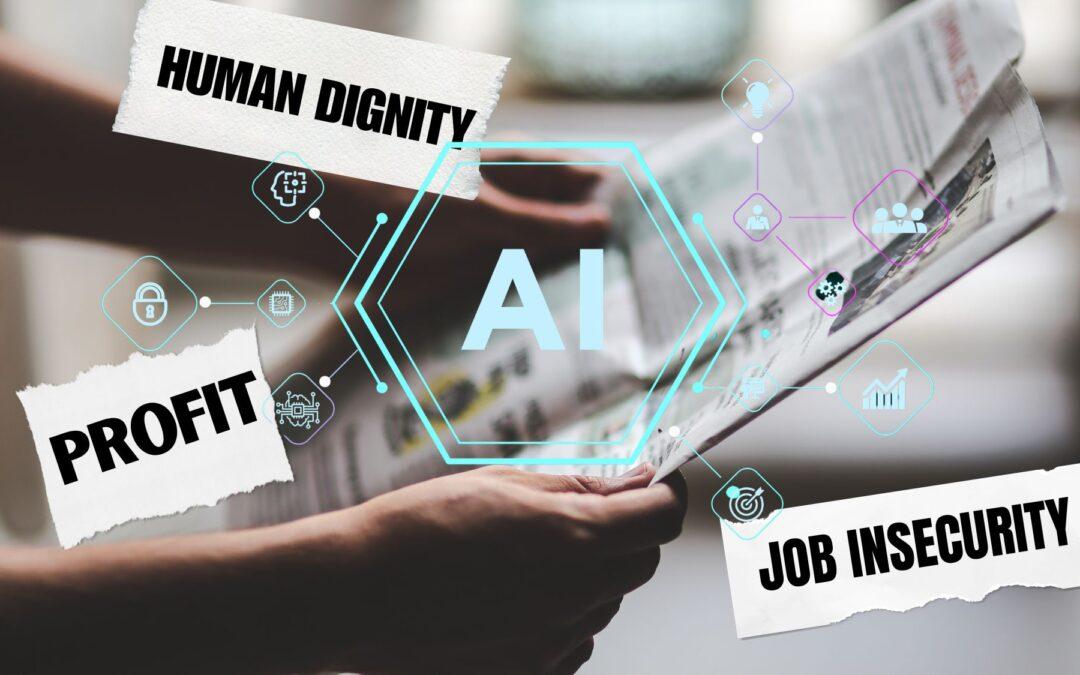
St. John Paul II recognized that unemployment is a grave evil. Indeed, when it reaches massive proportions, it becomes a true social calamity that especially requires the State to exercise responsibility. Today, amid the “fourth industrial revolution,” this concern is even more acute, as innovation is often pursued solely for reducing costs and increasing profits. In some contexts, there is a legitimate fear of a significant and rapid contraction in available jobs that would create a chain reaction deeply impacting families, young people and local economies. In many sectors, this can already be seen in new forms of job insecurity and inequality, characterized by outsized remuneration for a highly specialized minority alongside declining wages for a large portion of the workforce…
The labor market is one area in which the risks associated with new technologies more clearly emerge. It is thus necessary to remember that economic freedom is not absolute; it must always be measured against the common good and the dignity of every person. Entrepreneurial initiative can indeed be a true vocation, generating wealth and improving lives, rather than a variable that is dependent only on profit. This is possible when it recognizes that the creation of dignified, valuable jobs are an essential part of its proper service to society…
More than ever, in the age of AI and robotics, it is no longer possible to rely solely on the “invisible hand” of the market. Politics has the task of orientating economies and technologies to the common good, promoting dignified work, social inclusion and an equitable distribution of the benefits of innovation. Since many economic decisions transcend national borders, there is also a need for international cooperation capable of defining common strategies, especially in favor of the most vulnerable countries and people, in order to promote development and overcome welfare dependency…
In practical terms, in the age of AI and robotics, ensuring that the economy favors human dignity means adopting certain criteria for firm action. First, transparency and accountability: when data and algorithms influence credit distribution, personnel selection or access to services and opportunities, it is necessary that decisions be understandable, contestable and subject to oversight, so that individuals are not reduced to mere profiles. Second, inclusion and access: the benefits of innovation must be paired with investments in skills, infrastructure and essential services to ensure that technology does not widen the gap between those who have and those who have not. Finally, measures to ensure equity: taxation, social protection and industrial policies must correct the imbalances created by the concentration of wealth and power. Indeed, these criteria do not constitute a curb on innovation; instead they make it civilized and humane.
More to come.
Peace,
Fr. Damian