
Dear Friends,
We have entered a new year. Have you made any resolutions to begin the year? Have you already broken them? I know that I am not very good at keeping resolutions. I think resolutions are good things if you keep them in balance. Goals, perhaps, are a lot more useful. Like I recommend for Lenten exercises each year, “don’t do anything that guarantees you’ll be frustrated. We are what we are.”
If you want to change something about how you are living, great, but don’t expect complete perfection by a certain date. Also, I think it is better to be more specific and to take things in small bites. For example, resolving to eat healthier is vague, resolving to eat three more vegetable servings per week and one less candy bar is probably doable. Perhaps you have read Atomic Habits by James Clear who gives lots of advice on how to take tiny steps that add up to major life changes.
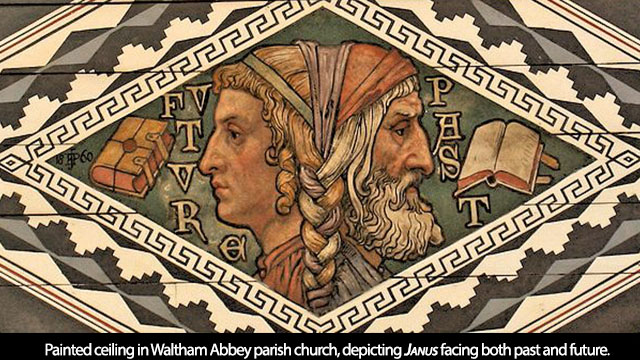
A quick Google search tells me that some historians believe the tradition of making New Year’s resolutions goes back as far as the second century B.C. Janus, a mythical king of Rome, stood at the head of the calendar with his two faces looking back on past events and forward to the future. Janus eventually became the symbol for resolutions.
In 46 B.C., January 1st became the first day of the New Year when Julius Caesar developed a calendar that more accurately reflected the seasons. The Romans named the first month of the year after Janus, who was also thought to be the god of beginnings and the guardian of doorways. He was always depicted with those two faces, allowing him to look backward and forward at the same time. At midnight on December 31st, the Romans imagined Janus looking back at the old year and forward to the new.
By the 17th century, New Year’s resolutions were common enough that people found humor in the idea of making and breaking their pledges. A Boston newspaper from 1813 featured the first recorded use of the phrase “New Year resolution.” The article states:
“And yet, I believe there are multitudes of people, accustomed to receive injunctions of new year resolutions, who will sin all the month of December, with a serious determination of beginning the new year with new resolutions and new behavior, and with the full belief that they shall thus expiate and wipe away all their former faults.”
Can we say we are not doing that? What might be a good thought to keep in mind as the year begins and we strive to do better? How about the first step of reaffirming what is important to you? To help with this, I offer you a selection from Paul’s Letter to the Philippians and highlight the things he recommends in this passage:
(Consider what is important in your life) But whatever was to my profit I now consider loss for the sake of Christ. What is more, I consider everything a loss compared to the surpassing greatness of knowing Christ Jesus my Lord, for whose sake I have lost all things. I consider them rubbish, that I may gain Christ and be found in him, …I want to know Christ and the power of his resurrection and the fellowship of sharing in his sufferings, becoming like him in his death, and so, somehow, to attain to the resurrection from the dead. Not that I have already obtained all this, or have already been made perfect, (chase what really matters) but I press on to take hold of that for which Christ Jesus took hold of me. Brothers, I do not consider myself yet to have taken hold of it. But one thing I do: (confirm your priorities) Forgetting what is behind and straining toward what is ahead, I press on toward the goal to win the prize for which God has called me heavenward in Christ Jesus. (claim what was promised) All of us who are mature should take such a view of things…. Only let us live up to what we have already attained.
Happy New Year!
Fr. Damian