
Dear Friends,
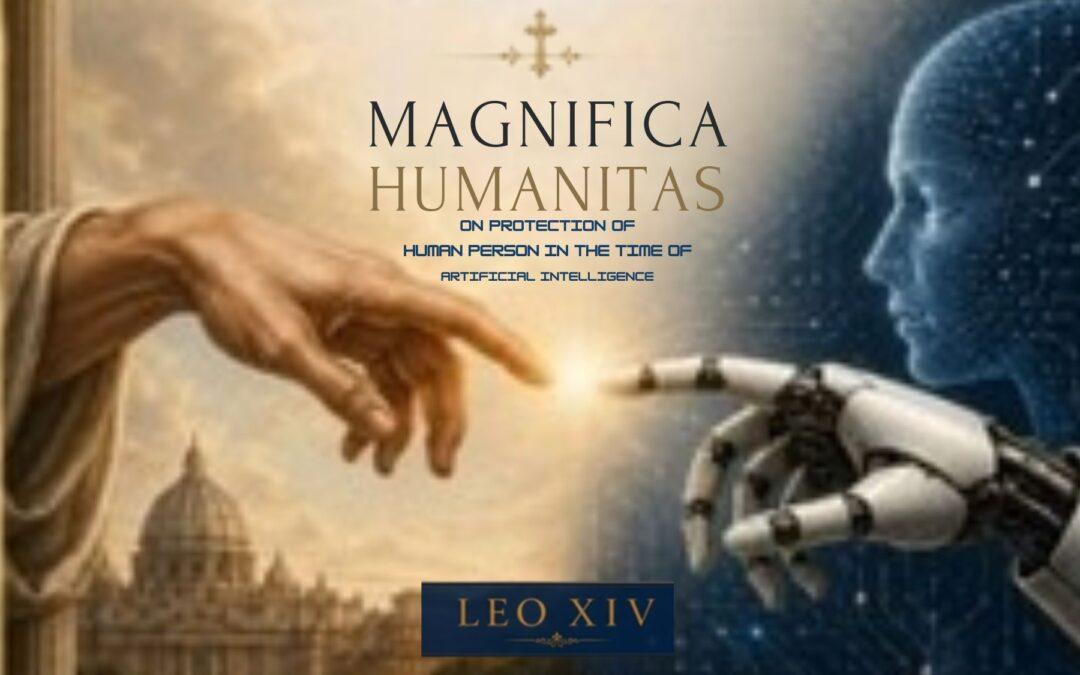
Some of our neighbors who are not Catholic may find it odd that the Holy Father has written an encyclical on the challenges humanity faces with the use of AI. Some of his critics do not think he has gone far enough and suggest he state that AI is always bad, while others think he should just stay away from any AI critique whatever.
Anticipating these critiques, Pope Leo says in the introduction: the Holy Spirit challenges us today regarding our relationship with technology and the ongoing digital revolution. Scientific discoveries are talents entrusted to humanity so that they may bear fruit. Technology has the power to heal, connect, educate and protect our common home; but it can also divide, exclude and generate new forms of injustice. In the abstract, technology in and of itself is not a solution to humanity’s problems, just as it is not inherently evil. In practice, however, technology is never neutral, because it takes on the characteristics of those who devise, finance, regulate and use it. Therefore, the primary choice is not between a “yes” or “no” to technology, but rather between constructing Babel or rebuilding Jerusalem; between a power that claims to dominate the heavens and a people who work together in the presence of God to rebuild the walls of fraternal coexistence.
As Pope Leo concludes his introduction to the Encyclical, Magnifica Humanitas, speaking of the four things necessary to build a city founded on the common good:
- Building a city founded on the common good implies, first and foremost, building on a firm relationship with God. It means recognizing that the truth of his love calls us to life “in all its fullness” and communion with him.
- Secondly, building for the common good means accepting the limits and weakness of humanity without considering them an error to be corrected. Today, the human desire for fullness of life is at risk of being misled by deceitful goals…The Church reminds us, with a firm yet humble voice, that true fulfilment is not achieved by eliminating weakness but through harmonious growth. It is found where freedom and responsibility are intertwined with mutual care and true solidarity, and where progress is measured by the dignity of each person and the good of all peoples.
- Thirdly, building a world in which everyone can flourish requires shared responsibility and courage. No one can single-handedly bear the weight of the challenges the world is facing, just as no one is so weak that they cannot play their part, for “power is made perfect in weakness”. All are given their own section of the wall…
- Finally, building for the common good requires an evangelical language. We must avoid humiliating or antagonistic words, opting rather for a clarity that sheds light and a frankness that unlocks new possibilities.
He concludes the introduction with these beautiful words: With the heart of a shepherd and a father, I ask everyone to abandon the construction of yet another Tower of Babel and to join forces in building up the common good, so that humanity will never lose its beauty, and the world once again will come to recognize the human heart as the place where God desires to dwell.
More next week.
Peace,
Fr. Damian