


Dear Friends,
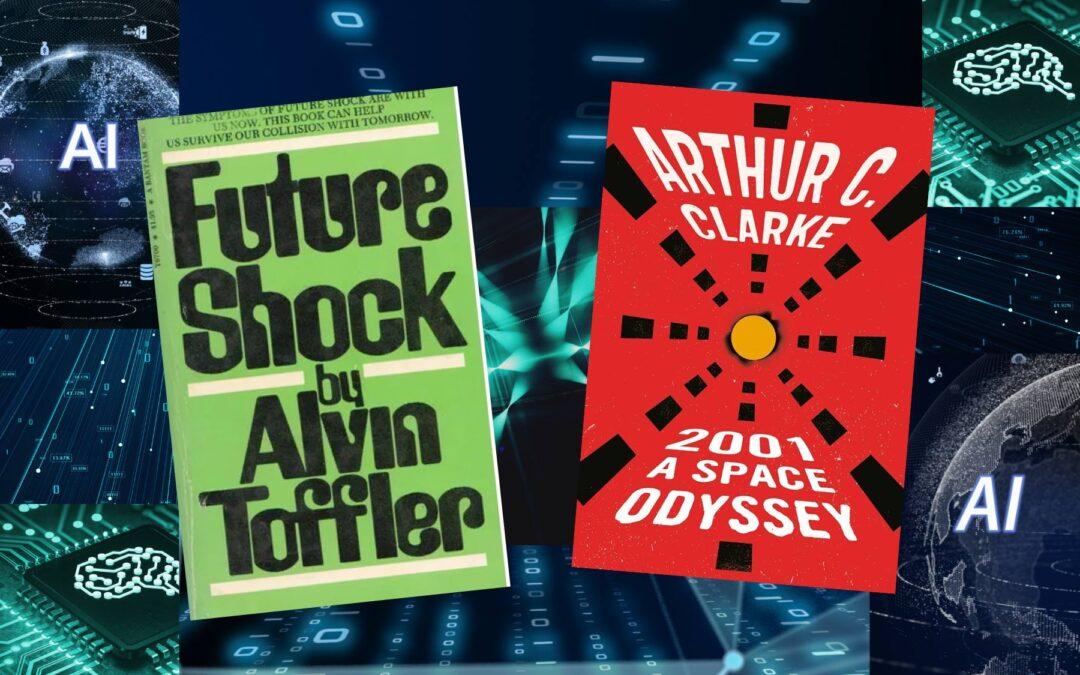
Back in 1970, when I was a sophomore in high school, Alvin Toffler and his wife wrote a book entitled Future Shock to describe what happens to societies and people when too much social change happens too quickly. Toffler died in 2016 but had predicted the “revolutionary transitions” that would lie ahead for humankind many years ago. He thought you and I would feel disoriented, irritable, and malaise as we sought to find our footing in a new reality.
I am not sure if he saw the world of AI that is quickly becoming a new part of our norm. Certainly, it was foreseen in 2001, A Space Odyssey with the conversations held with the computer, HAL. What seemed impossible only a short time ago can now take place between you and your AI agent. There are new stories daily about the type of robots that will be serving us soon. Even as I type this letter, some “helper” keeps making suggestions to me about the next word I should choose, or it corrects my grammatical mistakes.
Those things are minor in comparison to the concerns Pope Leo raises about AI in his encyclical Magnifica Humanitas. I mentioned in the letter last week several of the concerns that the Holy Father raises about unregulated AI. Early in the letter, he uses a strong word in approaching the morality of AI use, “to disarm”. He initially uses it generally and then later in the letter specifically about weapons.
Here is his statement found early in the encyclical: I would like to employ the expression “to disarm,” which is close to my heart. Disarming AI means freeing it from the mentality of “armed” competition, which today is not limited simply to the military context, but is also an economic and cognitive phenomenon. This entails a race for ever more powerful algorithms and larger datasets, driven by the desire to secure geopolitical or commercial dominance. To disarm means discrediting the assumption that technical power automatically confers the right to govern. To disarm does not mean rejecting technology, but preventing it from dominating humanity. It means freeing technology from monopolistic control and opening it to discussion and debate, therefore making it human-friendly and restoring it to the plurality of human cultures and ways of life. Our task today is not only ethical or technical. It is ecological in the deepest sense, for it concerns a new dimension of our common home. AI is already an environment in which we are immersed, as well as a force with which we must engage. For this reason, merely regulating it is insufficient; it must be disarmed, welcoming and accessible.
Pope Leo concludes this section by reminding us of what we humans are made to be: Having considered the issues of responsibility and governance of AI, we must now return to our central question: what does it mean to safeguard our humanity? The risk extends beyond the misuse of certain technologies. More gravely, the pervasive technocratic paradigm in which we are immersed, and that is amplified by the digital revolution and AI, threatens to normalize an anti-human vision. In that vision, the fullness of life is equated with having more, reducing weakness, eliminating uncertainty and exerting total control. When efficiency becomes the ultimate measure of value, human beings are tempted to see themselves as a project to be optimized rather than as persons called to relationship and communion…The quality of a civilization is measured not by the power of its means, but by the care it is able to offer, by its ability to recognize the other as a face not merely as a function. The ability to care for one another is a fundamental dimension of our humanity, one that is learned and mastered through lived experience. Reading stories to a child, offering company to an elderly person and arranging a home so that it is welcoming are simple gestures often rooted in family life…
More next week.
Peace,
Fr. Damian